Understanding Deep Learning: A Practical Introduction to Modern AI
🧠✨ Understanding Deep Learning: A Practical Introduction to Modern AI ✨🧠
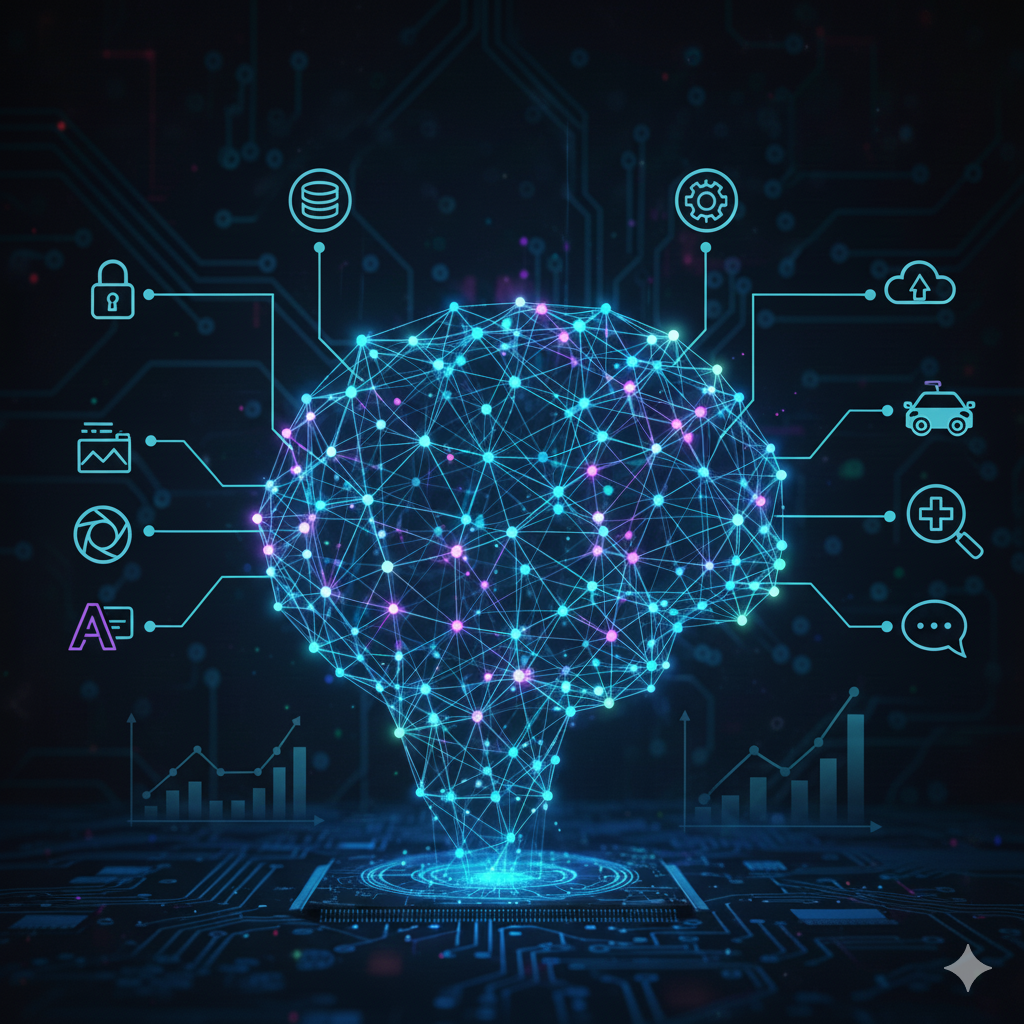
Artificial Intelligence has evolved rapidly over the last decade, and at the center of this transformation is deep learning. 🤖📈 Deep learning is a powerful branch of machine learning that enables computers to recognize patterns, make predictions, and solve complex problems that were once considered uniquely human. 🧩🧠
This article introduces the fundamental ideas behind deep learning, explains how neural networks function, and explores why these technologies are essential for building modern AI systems. 🚀💡
🔄 From Machine Learning to Deep Learning
Traditional machine learning models rely heavily on manually crafted features and limited model structures. 🛠️📉 Deep learning, by contrast, uses layered neural networks that automatically learn representations from data. 🧠📊 This ability to learn complex patterns makes deep learning especially effective in fields such as image recognition, natural language processing, and speech analysis. 🖼️🗣️📄
Deep learning models improve as more data becomes available, allowing them to scale efficiently and deliver increasingly accurate results. 📈✅
🧩 The Building Block: Artificial Neurons
At the heart of every deep learning system is the artificial neuron, a simplified mathematical model inspired by biological neurons. 🧠⚡ Each neuron:
• Receives numerical inputs 🔢
• Applies adjustable weights ⚖️
• Combines inputs into a single value ➕
• Passes the result through an activation function 🔄
By connecting many neurons together, neural networks can represent highly complex relationships in data. 🌐📐
📉 Training Neural Networks with Gradient Descent
Neural networks learn through an optimization process called gradient descent. 🏃♂️📉 During training, the model compares its predictions to actual outcomes, calculates the error, and then adjusts its internal weights to reduce that error. 🎯⚙️
This process is repeated over many iterations until the network produces accurate and reliable predictions. 🔁✅ Gradient descent is one of the most important concepts in deep learning because it allows networks to continuously improve their performance. 🚀📊
🏗️ Multi-Layer Perceptrons: Learning in Depth
A multi-layer perceptron (MLP) extends the idea of a single neuron into multiple layers:
• An input layer that receives raw data 📥
• One or more hidden layers that extract patterns 🕵️♂️
• An output layer that produces results 📤
Each additional layer allows the model to learn more abstract features, making MLPs suitable for tasks such as classification, regression, and pattern recognition. 🧠🔍
🧠🛠️ Specialized Neural Network Architectures
As deep learning matured, researchers developed specialized architectures designed for specific types of problems:
Autoencoders
Autoencoders learn efficient representations of data by compressing inputs and reconstructing them. 🔐🔄 They are commonly used for dimensionality reduction, noise removal, and anomaly detection. 📉🧹🚨
Convolutional Neural Networks (CNNs)
CNNs are optimized for image and visual data. 🖼️👁️ By applying convolution operations, they can detect edges, shapes, and textures, making them essential for computer vision applications. 📐🎨
Recurrent Neural Networks (RNNs)
RNNs are designed for sequence-based data such as text, time series, and speech. 📜⏱️🗣️ They maintain memory of previous inputs, allowing them to model relationships over time. 🧠🔁
💻 Applying Deep Learning in Practice
Modern deep learning is not just theoretical—it is highly practical. 🛠️📘 By implementing neural networks in programming environments such as Python, learners and professionals can:
• Build and test neural network models 🧪
• Simulate learning behavior 🔄
• Analyze model performance 📊
• Apply deep learning techniques to real-world datasets 🌍
Hands-on experimentation plays a critical role in understanding how neural networks behave and how architectural choices affect outcomes. 🧠🔬
🌍 Why Deep Learning Matters
Deep learning has become a cornerstone of modern AI because it enables systems to learn directly from data at scale. 📊🚀 From self-driving cars to medical imaging and language translation, deep neural networks are reshaping industries and redefining what machines can achieve. 🚗🩺🌐
Understanding the fundamentals of neural networks, training methods, and specialized architectures is an essential step for anyone looking to work with AI technologies or apply them effectively in real-world scenarios. 🎓🤖
✨ Final Thoughts ✨
Deep learning is more than a collection of algorithms—it is a powerful framework for building intelligent systems. 🧠🏗️ By mastering neural network components, learning how models are trained, and exploring specialized architectures, learners gain the foundation needed to innovate in today’s AI-driven world. 🚀🌟
See more blogs
You can all the articles below