How Multi-Layer Perceptrons Power Modern LLM
🧠 How Multi-Layer Perceptrons Power Modern LLM
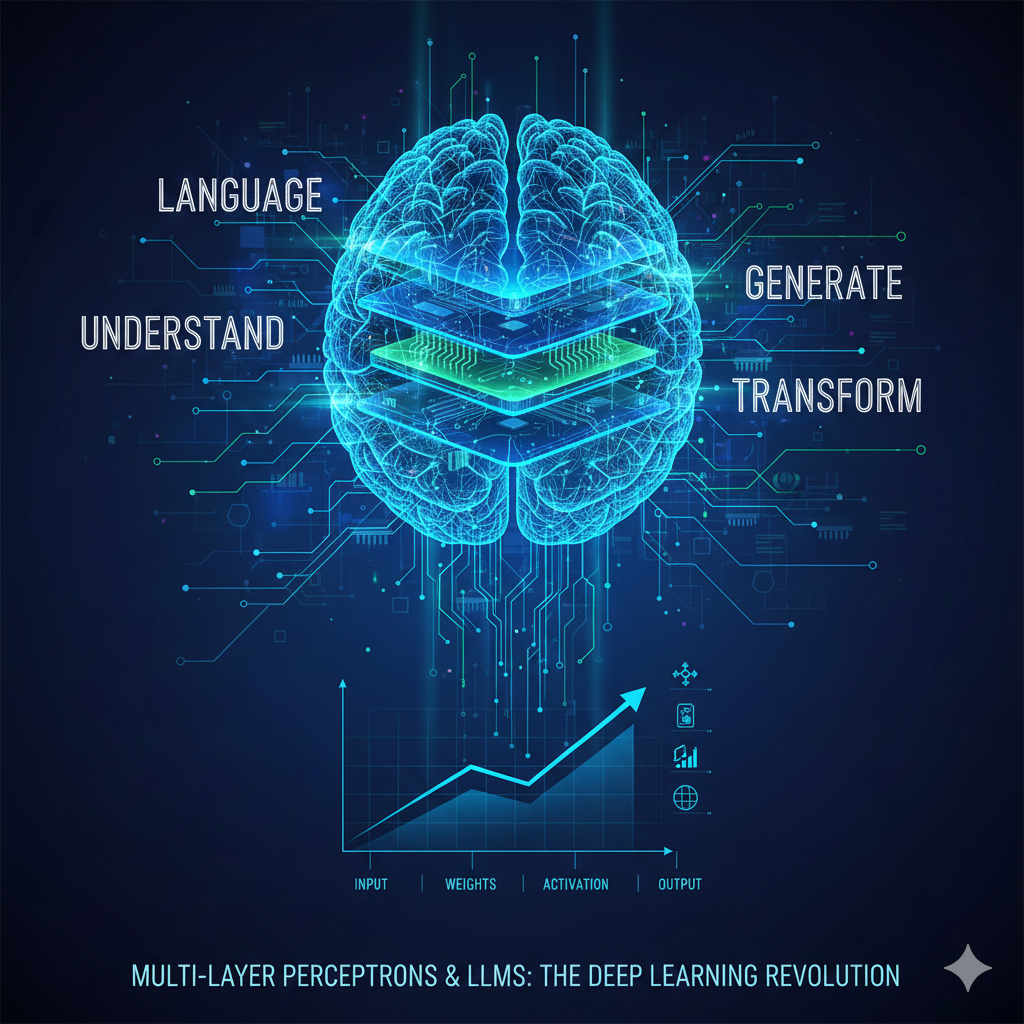
Large Language Model (LLM) software relies on deep learning architectures that can understand, transform, and generate complex information. One of the foundational components behind these systems is the Multi-Layer Perceptron (MLP)—a flexible neural network structure that enables advanced learning beyond simple linear models 🤖📊
🚀 Moving Beyond Basic Models in LLM Systems
Early machine learning models were limited in their ability to capture complex relationships. MLPs address this limitation by stacking multiple neural network layers, allowing LLM software to:
• Learn non-linear patterns in language data 📈
• Represent abstract concepts across multiple layers 🧩
• Adapt to diverse tasks such as classification, generation, and prediction 🎯
⚙️ How MLPs Work Inside LLM Software
An MLP processes data through a sequence of layers:
• Input features are multiplied by learned weights 🎚️
• Intermediate values pass through non-linear activation functions 🔄
• Each layer refines the representation learned by the previous layer 🧠
This layered processing enables LLMs to transform raw text embeddings into meaningful outputs such as responses, summaries, or classifications ✍️📄
🔄 Activation Functions and Learning Flexibility
MLPs gain their power from activation functions that control how information flows:
• Sigmoid functions support probability-based outputs 📊
• Tanh functions handle both positive and negative values ➕➖
• ReLU functions improve efficiency and scalability ⚡
Choosing the right activation function helps LLM software balance performance, speed, and accuracy 🎯
📉 Training MLPs with Backpropagation
LLM software trains MLPs using supervised learning:
• A loss function measures prediction quality 📏
• Gradient descent adjusts weights to reduce error 🔽
• Backpropagation distributes learning signals across layers 🔗
Modern frameworks automate these calculations and leverage high-performance hardware for efficient training 🖥️🚀
🎯 Conclusion
Multi-Layer Perceptrons are a critical building block of LLM software, enabling deep models to learn complex language patterns at scale. By combining layered structures, non-linear activations, and gradient-based optimization, MLPs help power the intelligent behavior behind today’s AI-driven applications 🤖🌍 Understanding MLPs provides valuable insight into how modern LLM systems are designed, trained, and deployed.
See more blogs
You can all the articles below