Deep Learning Foundations: How Neural Networks Drive Modern AI
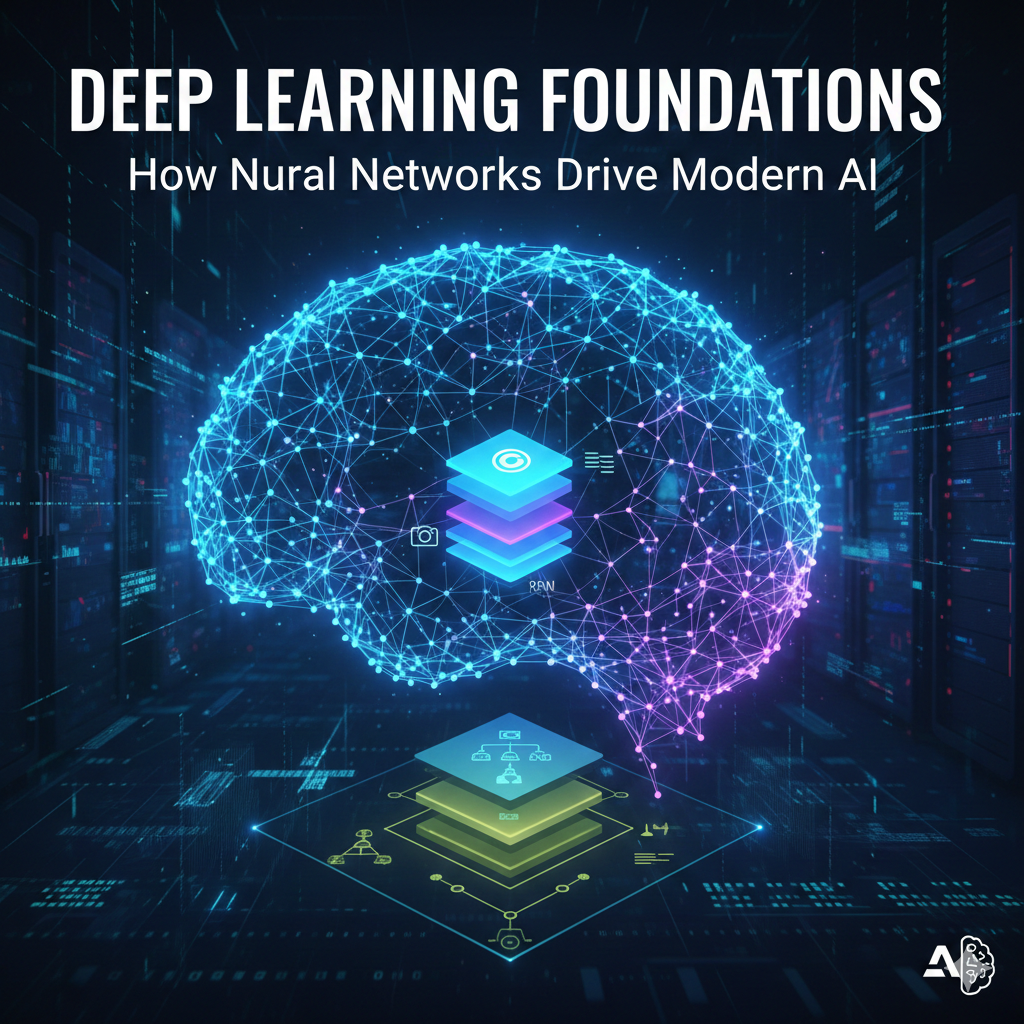
🧠✨ Deep Learning Foundations: How Neural Networks Drive Modern AI
Machine learning enables systems to learn from data, but deep learning significantly extends this ability 🤖📊. Rather than depending on simple algorithms and manually selected features, deep learning uses multi-layer neural networks to uncover complex patterns automatically 🔍🧩. Because of this, deep learning has become a fundamental technology behind many advanced AI solutions used today 🚀🧠.
1️⃣ Evolution from Machine Learning to Deep Learning
Early machine learning approaches relied on structured techniques to analyze data 📈📋.
These approaches included:
- Supervised, unsupervised, and semi-supervised learning methods 🏫🤝🔎
- Parametric and non-parametric models 📐📉
- Algorithms such as linear classifiers, regression techniques, and decision trees 🌳📊
- Probabilistic models, including Bayesian frameworks 🎲📚
While effective for simpler problems, these methods often struggled with large-scale or unstructured data ⚠️📦.
2️⃣ The Role of Neural Networks
Deep learning advances traditional machine learning through the use of neural networks 🧠⚙️.
Key characteristics include:
- Neural networks support both classification and numerical prediction tasks 🏷️🔢
- Multi-layer perceptrons (MLPs) enhance learning by stacking multiple processing layers 🧱🧠
- Each layer extracts increasingly abstract representations from the data 🔄📊
This hierarchical learning process enables models to capture more complex relationships 🔗✨.
3️⃣ Development of Advanced Neural Architectures
As neural networks grow deeper, they gain greater learning capacity 📈🧠.
Notable architectures include:
- Convolutional Neural Networks (CNNs), designed for image and visual data 🖼️👁️
- Recurrent Neural Networks (RNNs), optimized for sequential information such as text and speech 📝🎙️
- Flexible structures that support diverse AI applications 🔧🌐
However, these advanced models also require careful tuning and efficient training strategies ⚙️⏱️.
4️⃣ Benefits and Challenges of Deep Learning
While deep learning offers powerful capabilities, it also presents practical challenges ⚖️🧠.
Important considerations include:
- High data and computational requirements 💾💻
- Difficulty in interpreting model decisions 🕵️♂️❓
- Maintaining stability during training and optimization 🔄⚠️
✅ Conclusion
Deep learning enhances machine learning by allowing neural networks to learn complex patterns at scale 🌍🧠. With architectures such as MLPs, CNNs, and RNNs, deep learning supports a wide range of modern AI applications 🤖📱. A solid understanding of these foundations is crucial for developing reliable and effective artificial intelligence systems in today’s digital landscape 🔐🌐.
See more blogs
You can all the articles below