Understanding Key Machine Learning Methods and How They Work
Understanding Key Machine Learning Methods and How They Work 🤖📘
Machine learning is one of the core drivers of modern AI. However, many people assume it is only about deep learning. In reality, machine learning includes a wide range of techniques designed to solve different kinds of problems. This module introduces learners to these major categories and explains how each method works at a high level.
1. How Models Learn From Data 📊🎯
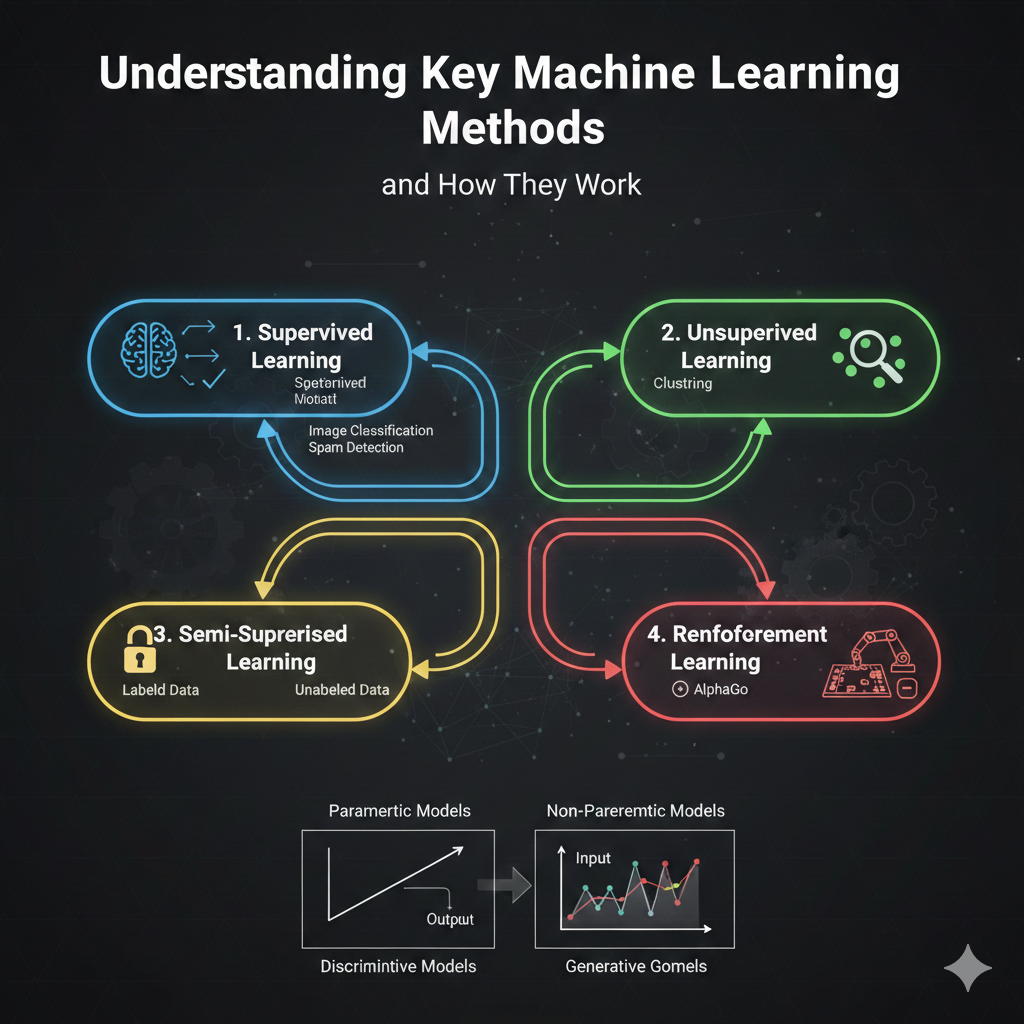
The module begins with supervised learning, the most widely used training approach.
• Models learn from labeled examples where both inputs and outputs are known. 🏷️
• Ideal for tasks like image classification, spam detection, and sentiment analysis. 🖼️📩😊
• The model identifies patterns in the labeled data and uses them to make predictions. 🔍➡️📈
2. Unsupervised Learning: Finding Patterns Without Labels 🧩🔎
In unsupervised learning, no labels are provided.
• Algorithms search for structure or hidden patterns within the data. 🕵️♂️
• Clustering methods group similar items together. 🧃🧃🧃
• Useful for customer segmentation, anomaly detection, and exploratory analysis. 👥⚠️🔍
This approach is powerful when labeled datasets are unavailable. 💡
3. Semi-Supervised Learning: Bridging Two Worlds 🌗🤝
Semi-supervised learning uses:
• A small amount of labeled data 🏷️
• A much larger amount of unlabeled data 📦
This method is practical because labeling data is often costly or time-consuming. It frequently delivers better results than supervised learning alone when labels are limited. 🚀
4. Reinforcement Learning: Learning by Trial and Error 🎮🤖
Reinforcement learning teaches models through interaction.
• The algorithm takes actions, receives rewards or penalties, and adjusts its strategy over time. ⚖️🔁
• Applied in robotics, autonomous systems, and game-playing AI. 🤖🚗🎲
• Famous example: AlphaGo, which mastered the game of Go through self-play. 🏆
5. Parametric vs. Non-Parametric Models 🧱📈
Learners also compare two types of model structures:
• Parametric models: Fixed structure that doesn’t grow with more data. 📏
• Non-parametric models: Flexible structure that expands as more data is added. 🌱➡️🌳
This distinction is helpful when selecting models based on data size and complexity. ⚙️
6. Discriminative vs. Generative Approaches 🎯✨
The module concludes with two major modeling philosophies:
• Discriminative models predict outputs from inputs (e.g., classifying images). 🖼️➡️🏷️
• Generative models learn how data is produced and can create new examples. 🧠🎨
These approaches help define the kinds of tasks a model is best suited for. 🛠️
Machine learning is a diverse and powerful field. Understanding these core methods gives learners the foundation they need to choose the right technique for any AI challenge. 🚀📚
See more blogs
You can all the articles below