Bayesian and Probabilistic Models in Machine Learning
✨📊 Bayesian and Probabilistic Models in Machine Learning 📈🤖
Bayesian and probabilistic models play a crucial role in machine learning because they do more than generate predictions—they estimate how confident the model is in those predictions. By reasoning with uncertainty and updating beliefs as new data comes in, these models become highly effective for real-world AI applications.
🧠🔢 1. Understanding Probabilistic Thinking
Unlike simple classifiers that output a single label, many machine-learning models—including decision trees—can produce probabilities.
Probabilistic models use probability density functions (pdfs) to express uncertainty in:
• The input data
• The model’s predictions
• The underlying parameters
This reflects an important reality: most real-world predictions are not absolute, but fall along a spectrum of likelihood.
📘📉 2. How Bayesian Methods Work
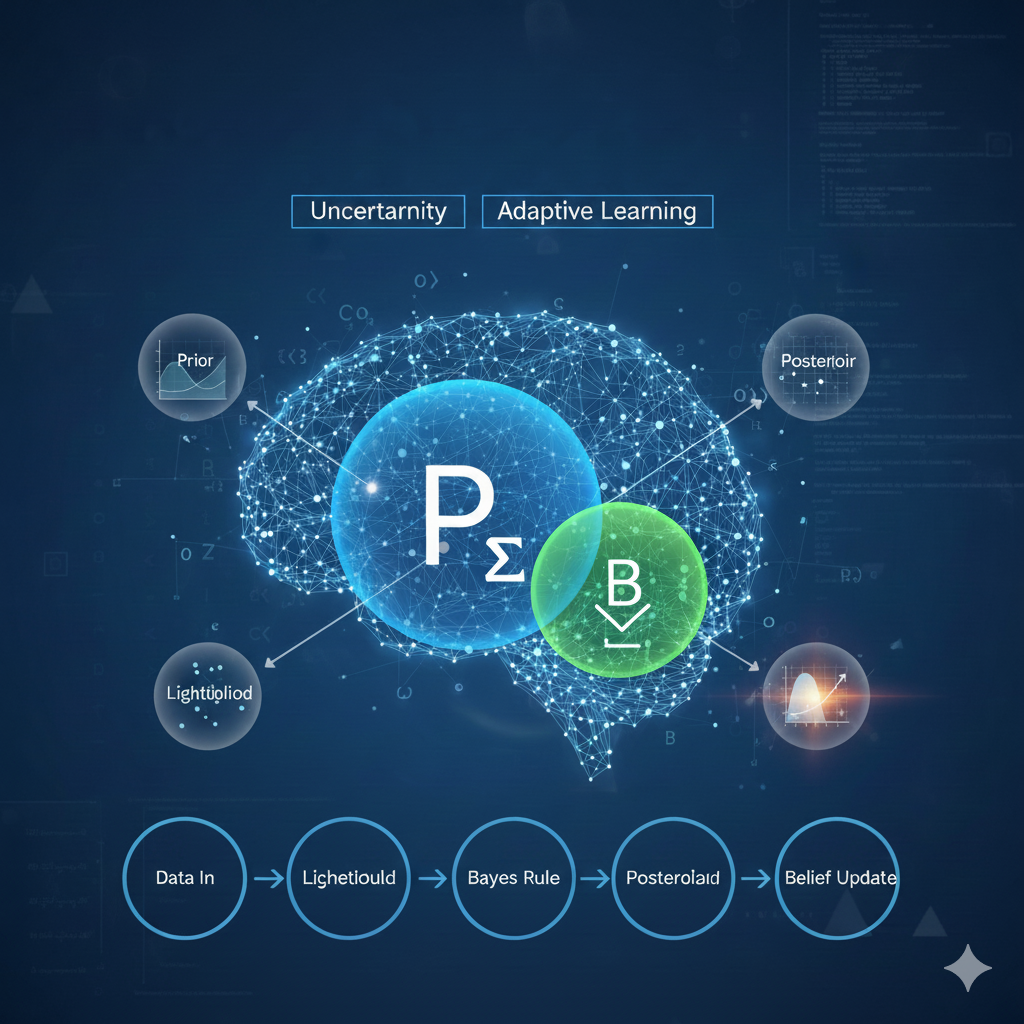
Bayesian learning starts with a prior belief, representing what we assume before observing new data.
• The prior may assume a parameter follows a known distribution, such as a Gaussian.
• When new data is observed, we calculate the likelihood, showing how well different parameter values fit that data.
• Using Bayes’ rule, the prior and likelihood are combined to create the posterior belief—an updated understanding based on all available evidence.
As more data arrives, the model continually updates its beliefs, improving accuracy over time.
🌟🎯 3. Benefits of Bayesian Approaches
Bayesian models offer several strengths:
• They incorporate both prior knowledge and new observations.
• They naturally manage uncertainty and noisy data.
• They support adaptive learning, helping select the most valuable data points when data collection is costly.
🔍📘 4. A Simple Example
Imagine assigning initial probabilities to different hypotheses. When a new event—such as “A”—occurs, Bayesian updating increases the probability of the hypothesis that best explains that event. This shows how models learn incrementally from evidence.
🏁🤖 Conclusion
Bayesian and probabilistic models provide a powerful framework for learning in uncertain environments. Their ability to update beliefs, measure confidence, and adapt over time makes them essential tools in modern AI and statistical modeling.
See more blogs
You can all the articles below